
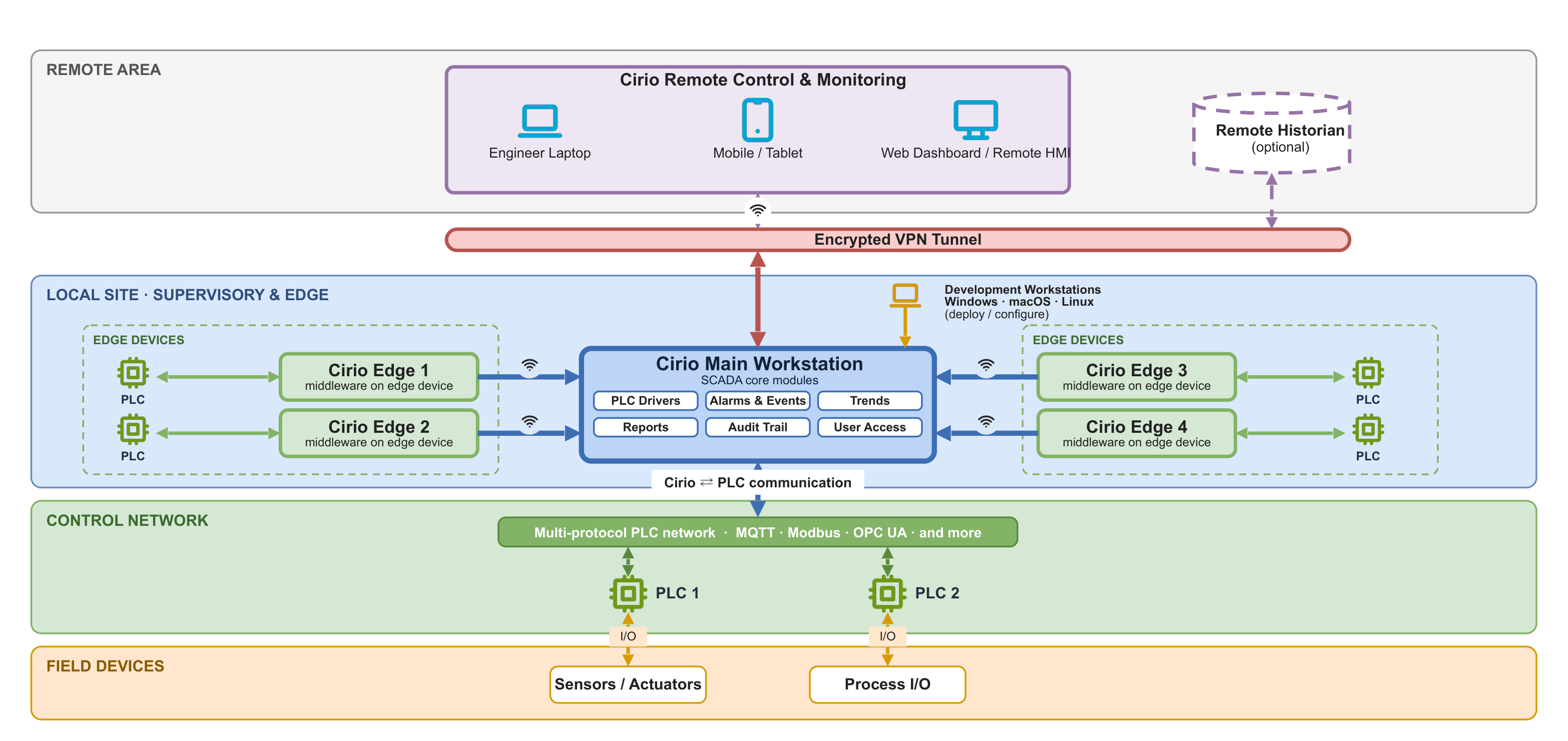
Industrial SCADA Topology · Field Devices → Multi-Protocol PLCs → Edge Middleware → Supervisory Control

SCADA architecture: four-tier topology and store-and-forward

Inspired by modern industrial SCADA topology principles, Cirio establishes an open, four-tier architecture across physical Field Devices & Power Meters, Multi-Protocol PLCs, Edge Middleware & Outage Spool nodes, and Supervisory Workstations & Encrypted Remote Supervision. Engineered for resilient plant operations with gap-free data capture through network outages, local NVMe ring-buffer spooling, and open database integration.

4 Plant Tiers

Field to remote supervision

In-Process Drivers

No third-party OPC servers

Outage Spooling

NVMe store-and-forward

Distributed Scale Progression · Architecture Roadmap

Eliminates long serial runs
Step 1 · START

1 Edge, one production line

PLC → Edge → Workstation

Step 2 · EXPAND

4 Edges, multiple plant lines

Multiple Edges → Central Workstation

Step 3 · FULL PLANT

25+ Meters & PLCs

History DB + Workstation + MES

System Topology & Architecture

Complete Plant Topology: From Field Devices to Remote Supervision

Cirio connects your entire industrial operation across four coordinated zones — bridging physical field devices, control networks, supervisory workstations, and encrypted remote access without third-party OPC middle layers.

TOPOLOGY ZONES:
Official SCADA Architecture
Cirio SCADA End-to-End Plant Architecture Diagram showing Remote Area, Local Site Supervisory & Edge, Control Network, and Field Devices
Click to view full high-resolution diagram
Cirio Edge: Middleware at the machineMain Workstation: Core supervisory engineEncrypted VPN Tunnel: Zero-trust link
Click diagram or expand button to inspect in full resolution

Customer Value

Why Engineers and Plant Managers Choose Cirio Architecture

Store-and-forward

Outage-Resilient Data Capture

When central databases or network links go offline, Cirio Edge buffers alarms, events, and historian records locally and forwards them in order upon reconnection — with dropped samples accounted for.

Multi-protocol

Protects Installed Assets

Unifies MQTT, Modbus, Siemens, and OPC UA on a single architecture. Existing PLC programs stay intact, eliminating rip-and-replace costs.

Alarms & Trends

Early Fault Detection

Continuous live trending tracks process variables before thresholds are crossed, alerting operators to drift and providing historical data for root-cause analysis.

Zero-Trust VPN

Secure Remote Operations

Engineers access live dashboards from laptop, tablet, or phone over an encrypted VPN tunnel with fine-grained role permissions, reducing site-travel overhead.

Plant Scalability

Scales From a Single Line to the Full Plant

Modular Edge Architecture
Step 1 · Start1 Edge

One Production Line

Deploy a single Cirio Edge alongside the primary machine PLC for focused data capture and local alarming.

Step 2 · Expand4+ Edges

Multiple Lines, One System

Add Cirio Edge devices across plant lines, linking wirelessly or via plant LAN to the central supervisory workstation.

Step 3 · Full Plant25+ Meters & PLCs

Full Plant & Enterprise Integration

Scale with an external time-series history database, multi-operator consoles, and MES/ERP integration over OPC UA.

Related: the driver families, the capability inventory and the solutions.

Runtime stack

The four-layer runtime

Direct field sockets at Layer 1, up to the desktop operator console at Layer 4 — one codebase, no middleware hop.

Gap-after-settle scan loop
CIRIO RUNTIME ARCHITECTURE & SYSTEM TOPOLOGYFour layers, one process, in your own deployment
LAYER 4 • OPERATOR SURFACES
Desktop application and browser console, both served by the same runtime
DESKTOP + BROWSER
LAYER 3 • ALARMS, AUDIT CHAIN & AUTOMATION
An ISA-18.2-style alarm lifecycle, a tamper-evident change history, and sandboxed automation
LIFECYCLE + CHANGE HISTORY
LAYER 2 • TAG TABLE & STORE-AND-FORWARD
Live values under familiar names, with a bounded local buffer to the historian
BOUNDED BUFFER, COUNTED DROPS
Tag table
Live values under the names your operators use, with deadbands and scaling applied on the way in
Changed values only, by default
Store-and-forward buffer
While the historian link is down, a local buffer holds samples and refills them on reconnect. It has a ceiling, and when it fills the lost samples are counted and shown to the operator
Caps published on this page
Historian
Writes to the historian backend you choose — four are available
Your choice, your database
LAYER 1 • MULTI-PROTOCOL CONTROLLER DRIVERS
Direct field sockets in-process, with no external OPC server in the path
NATIVE FIELD DRIVERS
Selected layer:Where the readings live while they wait
Driver socket → tag table → historian write → browser broadcast

Every layer runs as one service on hardware you control. No external OPC server sits in the path, because the drivers are built in — and nothing on this diagram has been run against a controller yet.

Soft real-time by design: one scan cycle in flight, gap-after-settle
Documented in driver protocol matrix

4-Tier Plant Topology

Four-Tier Plant Architecture Breakdown

Inspired by premier industrial SCADA topology architectures, Cirio maps the complete plant environment into four distinct operational tiers — from physical single-line power meters and multi-protocol PLCs to edge NVMe outage spooling and multi-display control room supervision.

Tier 1Tier 1 · Field Instrumentation

Field Devices & Power Meters

Direct electrical and instrumentation integration bridging multifunction energy meters, electrical single-line monitoring, discrete states, and analog process sensors.

  • E&I single-line integration: captures soft real-time electrical telemetry including voltage, current, active power (kW), reactive power (kVAR), frequency, and power factor across switchgear panels
  • Discrete & analog process I/O: monitors 4-20 mA current loops, 0-10 V signals, RTDs, thermocouples, flow meters, pressure transmitters, level sensors, and digital limit switches
  • Ingress deadband & scaling: engineering units and deadbands applied at acquisition boundary to eliminate network bus chatter and suppress jitter
  • Timestamp fidelity: physical measurements receive origin timestamps at ingress, preserved through downstream historian ingestion
Available

Instrumentation placement: Installed directly at switchgear, motor control centers (MCC), and process machinery across the plant floor.

Tier 2Tier 2 · Controller Layer

Multi-Protocol PLCs

Native in-process communication drivers linking multi-vendor industrial controllers directly over Ethernet and serial buses without third-party OPC servers.

  • Multi-vendor controller support: native drivers for Siemens S7 (S7-200 SMART, 300, 400, 1200, 1500), Modbus TCP/RTU, Allen-Bradley (EtherNet/IP), Mitsubishi (MELSEC), Delta, and Schneider Electric
  • Capital investment protection: connects directly to installed plant PLCs and drives, preserving existing validated ladder logic without rip-and-replace
  • In-process driver execution: native driver sockets run directly inside the runtime process — eliminating third-party OPC server crashes and per-channel licensing surcharges
  • Sequential soft real-time polling: initiates each polling cycle only after the current transaction settles (gap-after-settle), preventing PLC Ethernet buffer overruns
Available

Execution: In-process communication threads managed with gap-after-settle discipline, avoiding controller network card exhaustion.

Tier 3Tier 3 · Edge Middleware

Edge Middleware & Outage Spool

Distributed DIN-rail edge nodes situated beside machines, equipped with local NVMe ring-buffered store-and-forward sequence forwarding on reconnect.

  • Distributed machine placement: compact DIN-rail edge gateways positioned right beside machines to eliminate long, noise-prone RS-485 serial runs
  • NVMe local ring-buffer: when central network links or WAN connections drop, incoming telemetry is spooled locally with millisecond timestamps intact
  • Store-and-forward sequence forwarding: upon network restoration, queued samples are forwarded in order to the central historian without saturating bandwidth
  • Pluggable database backends: supports PostgreSQL and QuestDB time-series storage engines with standard SQL access
Supported historian backendsPostgreSQL · QuestDB

Enterprise postgres and questdb relational & time-series storage.

Available

Deployment: Enterprise PostgreSQL and QuestDB for centralized time-series storage (SQLite and a dedicated time-series engine are supported for edge telemetry).

Tier 4Tier 4 · Operations & Supervision

Supervisory Workstations & Encrypted VPN Remote Operations

Dedicated multi-display control room operator consoles and zero-install mobile browser monitoring over encrypted VPN tunnels without public port exposure.

  • Multi-display control room: engineering and operator workstations (Windows, macOS, Linux) with high-density trend pens, mimic diagrams, and alarm consoles
  • Mobile Browser Access: responsive browser access for roaming supervisors, plant managers, and on-call engineers across tablets, laptops, and smartphones
  • Encrypted VPN perimeter: remote access connects through an encrypted VPN tunnel into the on-site plant LAN — zero public inbound ports and no third-party SaaS cloud dependencies
  • Strict role-based access: default roles (Administrator, Manager, Supervisor, Engineer, Operator, Viewer) with custom role definition across protected resources, ensuring operational isolation between view, operate, and configure modes
Available

Access policy: Every operator control action is authenticated, role-verified, and appended to a tamper-evident SHA-256 audit ledger.

Outage Survivability · Architecture Deep Dive

Offline Survivability & Store-and-Forward Spooling

Industrial networks face physical reality: severed fiber cables, switch power cycles, intermittent wireless bridges, and scheduled database maintenance. Cirio prevents data voids by pairing distributed edge middleware with an outage-resilient NVMe spooling engine.

Phase 1Normal Operation

High-Cadence Ingress & Soft Real-Time Polling

The edge runtime polls field PLCs and power meters using a gap-after-settle sequential loop, writing values to local memory tables and streaming them forward to the central historian.

Phase 2Outage Detected

Network / WAN Severance Detection

When an industrial switch reboots, a fiber line is severed, or a WAN connection drops, the edge poller detects the socket disconnection within milliseconds and immediately diverts storage payloads.

Phase 3Local Spool

Local NVMe Ring-Buffer Spooling

Instead of discarding readings, edge middleware buffers incoming process samples, alarm transitions, and audit records into a local NVMe ring-buffer with millisecond origin timestamps intact.

Phase 4Recovery Stream

Controlled Sequence Forwarding on Reconnect

When connectivity returns, the store-and-forward engine begins flushing historical batches chronologically in rate-limited batches (default 5,000 samples per flush) without choking network bandwidth.

Phase 5Gap-Free Capture

Automatic Backfill & Gap-Free Historian Records

Historical samples backfill seamlessly into the central database. Operator trend charts display complete, continuous historical records without flatlines, voids, or missing outage windows.

Phase 6Auditable Bounds

Drop Accounting & Quarantine Protection

If an extreme outage exceeds the 1,000,000-sample buffer ceiling, admission gates apply backpressure, dropped counts are logged, and corrupt records are quarantined rather than retried forever.

Store-and-forward

For resilient historian connectivity

When network links fail between edge runtimes and central historians, samples are held safely in a bounded buffer and automatically backfilled upon reconnect, with buffer counts and dropped samples exposed directly to operators.

Local buffer → historian
Store-and-Forward Topology & Failover Flow
01 · Data IngressContinuous Historian
Edge Field Poller

PLCs and field meters are polled with soft real-time sequential cadence, acquiring telemetry and alarms at the edge.

Payload: Tag samples + origin timestamps
02 · Link Monitor & BufferGate Enforcement
Admission Gate & Spool
Link UP: Direct live ingestion stream to central database
Link DOWN: Queued in 50k local SQLite spool (up to 1M ceiling)
Overfill ProtectionDrops Counted
03 · Delivery & BackfillZero Historian Gaps
Central Historian

Upon link reconnection, the edge automatically backfills stored readings in FIFO sequence without saturating plant bandwidth.

Target: PostgreSQL · QuestDB · SQLite
Edge Acquisition → Link Health Check → Local Bounded Spool (if severed) → Automatic Resync Backfill5,000 samples / flush batch
Store-and-forward buffer · SIMULATEDSIMULATED · illustrative model · 84 B/sample · 500 ms tick

Edge admission gate

50,000 samples ceiling
00 MiB / 512 MiB budget

Edge buffer · sample size is an illustrative assumption, not a measured value

With the link cut, offered samples arrive faster than the 3,000 ms scan can drain them. Once the gate is full the surplus is refused, not queued — the poll loop itself is soft real-time and keeps its interval either way.

LINK UP

Drop accounting

Available
0samples refused by the admission gate

The operator-facing history warning renders the lost sample count and the window it covers.

Admission gate
50,000 samples
Buffer ceiling
1,000,000 samples
Serialized byte budget
512 MiB
Flush batch size
5,000 samples
Store-and-forward supports delivery retries after an interruption. The operator can see buffer status and the count of samples refused at the configured limit.Edge buffer · visible status · counted drops
Security & Access Control

Enforced Security, Authentication & Audit Integrity

Granular role-based permissions, cryptographic lease verification, and an append-only audit trail engineered for plant integrity.

Audit trailAvailable

Audit chain: SHA-256 hash chain

Each record carries previousHash and its own recordHash. Unkeyed, unsigned, no Merkle tree.

This is what tamper detection costs and what it does not buy. It is not a signature, and it is not a claim of conformity with any standard.

  • Genesis is 64 zeros — the chain starts from a constant every verifier can reproduce.
  • Each record's previousHash is inside the hashed payload, so a rewritten record invalidates every record after it.
  • The chain head is read FOR UPDATE inside the append transaction, so two concurrent writers cannot fork the chain.
  • Full-chain verification walks the ledger under an isolation level that cannot see a shifting snapshot, and a row hidden behind its own checkpoint is reported as an integrity failure.
Lease signinglicence signing only

The licensing Authority signs machine leases; the runtime verifies them against an embedded public key. Not applied to the audit chain.

“The audit records include hash metadata for tamper detection, but this is not regulatory certification or a claim of electronic-signature compliance. Deployments still need operational and infrastructure controls.”
Access model

Local accounts, enforced locally

Authentication is local and the algorithm is pinned on every verification, so a token presented under a different scheme is rejected rather than reinterpreted.

  • Passwords are hashed with bcrypt at cost 10
  • The signing secret is generated per installation and written to disk at owner-only permissions (mode 0600)
  • Access tokens last sixty minutes and carry a session id, so signing in elsewhere revokes the older session
  • Local operator and engineer accounts with salted bcrypt password hashing (cost factor 10), session-scoped JWT tokens, and strict per-installation signing secrets.
Available
Authorization

Default roles against protected resources

Permissions are a per-role map of resource and mode. Default roles are provided out of the box, and users can define and configure custom roles as needed.

  • Default roles (Administrator, Manager, Supervisor, Engineer, Operator, Viewer) with full support for creating custom roles
  • users, apikeys and audit are excluded from the broad operational read default, so an ordinary role never reads them
  • One enforcement point: every annotated route authorizes through the same compiled policy before its guards and handler run
Roles and resourcesRole-based access

Administrator, Manager, Supervisor, Engineer, Operator, Viewer against views, commands, alarms, recipes, reports, scripts, notifications, devices, scheduler, logs, apikeys, users, audit, project, opcua, runtime.

Admin-only resourcesadmin-only

users, apikeys, audit — excluded from the broad operational read default.

Available
Remote access · Licensed feature

Remote is refused unless you say otherwise

Remote access is a licensed capability. There is one place that answers "what happens to a remote client while authentication is off?", and its answer is no by default.

  • Remote client and web access requires a valid product license; unlicensed installations refuse remote connections
  • With authentication disabled the console is open to in-house peers and remote access is refused unless the operator explicitly enabled it
  • Only six routes stay exempt so a remote client can boot, sign in and poll liveness. /api/mcp is deliberately not among them
  • The vendor states it plainly: a deployment with authenticationEnabled=false is insecure by design, and out of scope for security reports — SECURITY.md, Out of Scope
Available

Remote Operations & Cloud Topology

Secure remote access over encrypted VPN

Cirio enables live supervision and remote monitoring without routing critical plant telemetry through third-party multi-tenant SaaS clouds. Remote access from laptops, tablets, or mobile devices establishes an encrypted VPN tunnel directly into the on-site Cirio server on your plant LAN — maintaining strict perimeter defense and total data sovereignty.

Scope a deployment

Unified runtime container & desktop builds

Run native Windows, macOS, or Linux desktop applications for local operator consoles, or deploy the containerized runtime on your private cloud instances or on-premise servers.

Identical driver polling, tag processing, ISA-18.2 alarm dispatch, and historian interfaces across every deployment target.

Available

No multi-tenant vendor SaaS dependency

Remote access connects over an encrypted VPN directly to your on-site Cirio server on the plant LAN. Operators and supervisors view live screens, alarms, and trends from laptops, tablets, or phones without routing telemetry through a third-party SaaS.

Encrypted VPN path to plant LAN ensures total perimeter security and data sovereignty with zero external cloud dependencies.

Not available

100% offline & air-gap capable

Floor-level SCADA operations never depend on cloud connectivity. Edge runtimes, plant servers, and local historians continue uninterrupted during network outages, and air-gapped sites activate offline with a signed lease file.

Zero phone-home requirements. All live operational readings, tag historians, and cryptographic audit trails remain strictly inside your industrial network.

Available

Deploy on bare-metal industrial PCs, virtual machines, or cloud containers with complete data sovereignty and zero vendor SaaS dependency.

Deployment Positions

Deployment Positions & Practical Examples

Cirio breaks down into clear physical roles across your facility. Edge gateways run on compact hardware right beside sensors, feeding a central server managing PostgreSQL, with multi-platform desktop consoles and mobile browser views.

Near Sensors & PLCs

Edge Node

Raspberry Pi 4 / DIN-Rail IPC

Mounted on a DIN rail right beside field sensors or a feeder panel, polling Modbus RTU / S7 and spooling data locally if the link drops.

DB: Embedded SQLite (cirio-local.db)
Plant Core

Central Server

On-Premise Industrial Server / VM

Runs in the plant server room, receiving telemetry from all edge gateways, managing central alarms, and recording trends in PostgreSQL or QuestDB.

DB: PostgreSQL / QuestDB
Control Room

Desktop Console

Windows, macOS, or Linux PC

Used by plant engineers and operators on multi-monitor workstations to build screens, tune PID loops, and monitor live mimics.

DB: Local project file cache
Shop Floor & Remote

Mobile / Browser Access

Rugged Tablet, Smartphone, or Laptop

Supervisors and maintenance staff walking the floor inspecting live machinery states and acknowledging alarms over secure plant Wi-Fi.

DB: No client storage required
DimensionEdge Node (Raspberry Pi)Central Server (PostgreSQL)Mobile / Browser Access
Hardware exampleRaspberry Pi 4, DIN-rail IPC near sensorsOn-premise industrial IPC, server, VMShopfloor tablet, smartphone, or laptop
Primary functionIn-process poller & store-and-forward bufferCentral runtime, alarms, and data loggingBrowser Access for roving inspection & alarm acknowledgment
Database handledLocal SQLite (spool buffer on dropouts)PostgreSQL / QuestDBZero install (served by runtime over HTTPS)